Storytellers.Indivisible
Changing the narrative of our time to reclaim and evolve democracy
Learn about the
Storytellers.Indivisible Experience
When you click, you will be subscribed to my course-teaching platform where you will have private, safe and free access to our Storytellers.Indivisible preparation, access and community.
Hi! Welcome to Storytellers.Indivisible.
Watch Maria walking you through everything in the video above. Or read the description below.
I am Maria Mar, author, poet, artist, storyteller, shaman and Citizen Leader participating in the pro-democracy movement to save our democracy.
Thank you for answering my invitation to become a storyteller for the moment we are living.
Some months ago I was listening to political analyst Heather Cox Anderson in her YouTube channel as she was contemplating the relation between culture and politics. She was saying that storytellers bridge the gap between citizens and their leaders. That got me thinking.

Maria Mar in an online Medicine Story as Pachamama, or Earth Mother.
Storytellers are the creative bridge between citizens and their leaders, between the individual and the culture and across the past and the present.
Heather was considering how powerfully people are responding to the artists who are stepping up to portray the profound challenge we face to save our democracy. She spoke of this connective role that storytellers play between the events of a time and how people respond to these events.
She was observing that when politicians appeal to people with agendas and solutions it is never as moving as when artists connect to us from deep within our emotional truth.
And this is the power of storytellers: we can help change the narrative of our time.
About Storytellers
Storytellers are weavers of the perceptual tapestry that influences the way we see and therefore the way we respond to the events, challenges and opportunities of our time.
Shamans have understood for centuries that perception creates our reality. This is not some New Age mumbo-jumbo. It's common sense. The way we perceive a situation determines how we respond to it, and that in turn determines the interaction and its outcome.
But what is a story? How can stories affect our perception of reality?
Stories are the way in which our human mind integrates reality. We use our senses to interpret a situation and then arrange it in the form of story, including a plot, characters, time and conditions, emotions and conclusions. We file that story in our memory not as a script, but as a living, breathing scene. And when we meet a similar situation, we open all the files that keep that story, emotions, beliefs, sensations, conditions, expectations and interpretations... all the pieces of the story fly out and rearrange themselves to interpret the new event through the lens of that old story.
Therefore, we use old stories to interpret new situations. For this reason, we can say that we see the world through stories. These stories can be our own story files or versions of reality that we have heard and stuck with us because of their strong emotional appeal or repulsion. They can be old myths, family stories, stories we learn at school, the stories in our culture or stories sold to us by leaders and influencers.
Authoritarians, sleezy marketeers and political manipulators are the villains in our field because they are willing to create stories that sell misinformation, terrorize people into survival-based fearful responses or trigger reactions by linking reality to past or potential dangers or evils.
In Storytellers.Indivisible, as members of the nonviolent pro-democracy movement that works to restore and evolve our democracy, we work to share stories that inspire, uplift, inform, empower and mobilize our people and also stories that dispel the misinformation, obfuscation and manipulation of our current regime.
“Stories are the only imagined structure that can lay down actual memories,
as if you had experienced the event directly in real life.
This gives story the alchemical power to rewrite reality.”
~Maria Mar~
We are all storytellers in the way we interpret and respond to the world, creating patterns of interactions as we retain or release memories and generate responses that become the narrative of our lives.
The grandmother passes on stories that may affect many generations. The mother may bring into that narrative new stories that contextualize the past to guide her child’s present. The child in turn may weave new imaginative stories with her unique being and fresh eyes as she meets the world.
We can say that we are made of stories!
Poet and feminist Muriel Rukeyser said once:
“The Universe is made of stories, not of atoms.”
Storytellers of Their Time
Those who respond to the call of becoming storytellers of their time have a key mission in the evolution of humanity.
When they align with the collective well-being, storytellers can help the people contextualize the past to serve the present. They can open our imagination to new possibilities, connections and solutions.
In that way, they enable the people to see the challenges and potential of the present with fresh eyes. In doing this, storytellers help change the narrative of our times, enabling the weaving of an optimal future.
That is a beautiful mission, full of creative possibilities. It is also a great responsibility that requires truth-speaking, deep listening, fluid, expansive thinking and research, love-based responses and a great care for humanity, earth and all creatures.
To a storyteller, you matter. Your life matters. You flourishing into your best potential matters. Freedom matters. Beauty matters.
A storyteller is pulled by the threads of evolution to help weave the best patterns for the future of all beings. At a time like the one we are experiencing, storytellers become vital in empowering the people to see the challenges they face clearly, to find the new, evolved possibilities in those challenges and to choose their responses from freedom instead of habit or fear.
In doing this, storytellers become a type of shaman, healer or minister of our human evolution. Storytellers in this sense usually have creative, expressive and communication skills and gifts and a passion for transformation, for helping effect the change people need to respond to reality in ways that create the best possible world for all.
Activating our Inner Storyteller
I've observed that there are vocations, seasons and experiences that create portals that activate our Storytelling genius.
Certain professions or vocations tend to facilitate becoming a storyteller. These usually include: writers, verbal storytellers, visual storytellers (artists, illustrators, crafters), people-persons who love conversation and are good listeners, teachers, performers—such as singers, musicians, dancers or actors—or historians and journalists focused on how the past and present affect the person and the collective.
Certain seasons in human life also lend themselves to become storytellers. This often takes place when elders—once the business production and the rearing of children are finished or leave more time—seek to share their life experience. When a person becomes wiser from their experiences and mistakes, they often feel compelled to gather a stories with lessons that can give both old and new context to the present.
Traumas, mistakes and challenges that we meet and overcome are also portals for a person to awaken her passion to share her experience in order to help those going through a similar experience. In that way, crisis can activate our storytelling genius. If you resonate with this description, then you may already be a storyteller or are called right now to become one to help us change the narrative of our time.
Storytellers.Indivisible is a natural fit for you if:
~ You love to listen deeply to people, to keep your finger in the People's Pulse, to inspire, empower and uplift others, to engage people in conversations that bring them together to seek or implement new solutions or collaborate in creating something new.
~ You are a Creative. If you love to tell stories, be it orally, visually, through sound/song, movement or in conversation, this is for you. You can take the Pulse of the People and craft with those voices your own story creations to transform our lives and inspire us to fight for democracy.
~ An Elder: If you find that you can't be as active in local events but you have time at home to do Storytelling Rounds online, and then you can share what you learned with your people; craft a yarn, answer questions, make us laugh (or cry), uplift our spirits… Then this is for you.
Why We Need Storytellers Now
We need Storytellers to help us meet several challenges that We, the People are facing in order to defeat this fascist coup. As storytellers, we can see these challenges as narratives that need to be transformed so that the problem reveals its possibility.
Here are 12 of the narratives that I've spotted as current challenges to our people in taking action to save democracy and which we as storytellers need to help transform in order to give democracy a win.
- To help change the narrative of fear, cynicism or despair that is keeping many people from joining the pro-democracy movement, speaking truth to power and taking action on behalf of our democracy. We need to grow the movement to 12 million people actively participating, so we need to help those who want to participate but are being held back by these emotions.
- To help change the narrative of those in desperation and passivity brought about by lack of information. Because the legacy media is not covering what the pro-democracy movement is doing and is in fact covering it up, this adds a huge challenge to our task of defeating this fascist coup. As I make my storytelling rounds I consistently meet people desperate for "somebody to do something" and people who are crying "we need a movement" and similar outcries. They simply do not know that there is a growing, active, massive nonviolent pro-democracy movement. Therefore, they are crying for one and desperate because they believe that nothing is happening, that democracy is already lost. Even when they see massive marches, some people still cannot connect those events with the existence of an organized, strategic movement that is already taking effective actions that are making changes. We urgently need to spread this information to grow the movement.
- To help change the narrative of those who do not understand how our nonviolent responses can defeat guns and violence. As a result, they only see defeat where We, the People are advancing and winning tactical victories. We need to help people see and think strategically so that they understand the power of what we are doing.
- To help change the narrative of those who keep focusing on the madman in the White House, the Destroyer and his regime and are missing the progress of the pro-democracy movement because they do not understand strategic resistance. The reality show in the white house constantly creates turmoil to keep the attention on them. And people become dejected and heartbroken. We need to bring the attention to the movement fighting for democracy and keep them engaged and informed.
- To help change the narrative of those whose health, happiness and power are being poisoned by this toxic regime, who spend their days in doom-scrolling and who struggle with anguish, their nervous system weakened by so much chaos and destruction. Whether they never join, give up or keep fighting; these people will burnout if we do not help them detox from the hatred fumes of this regime and renew their wellbeing. We need to help them sustain a state of consciousness that leads to the creation of the world we want-- instead of making them susceptible to stay trapped in the destruction taking place by this regime.
- To help change the narrative of those who have participated in national protests, but… wonder if that has any effect, since the regime is still wreaking havoc. The right wing is mocking the protests as whinning and portraying them as ineffective and pathetic. People who want to stop this regime often hear many ignorant people question what can a protest do against this regime. And they get deflated and weakened, so they consider giving up. Again, we need to spread the strategies behind the tactics of national protests, nonviolent resistance and consistent noncompliance, to invite them to trainings that can help them protect their communities against ICE, defend our democracy effectively, weaken the regime and protect our freedoms and rights. Understanding leads to engagement. This is our priority at the moment.
- To help change the narrative of those who are shaming and blaming others for voting for the Destroyer, not voting, or for any other reason. These attitudes trap us in division when our success depends on Unity. We need to help them understand that we need to release divisionism and shift into Unity in order to create a cross-partisan massive movement that defeats this fascist coup. We need to learn to listen without judgment to people who think very differently, in the acceptance that we come together to defend something bigger than our differences: our democracy, freedom, country and our world.
- To help change the narrative of lies and obfuscation spread by a mainstream media that has been bought and paid-for by the oligarchy and therefore only repeats the Destroyer’s lies while covering up the pro-democracy advances. We have to convey a clear, powerful picture of the pro-democracy movement, tell its story and engage the people as players in that story. We have the seemingly impossible task of spreading the news about the pro-democracy movement across the nation-- in spite the cover up of legacy media. This means that each of us needs to use Word of Mouth, the quickest most powerful communication and promotional method in the world-- to spread the word.
- To help change the narrative of those who cannot connect the many dots in this chaotic destruction and therefore feel fragmented and disoriented. Our storytellers can help them see how the pro-democracy movement is weaving a new reality. We can help them connect popular resistance in the streets with increasing noncompliance in institutions and local grassroots organizing with the decrease in popularity of the regime. There are too many crazy things happening all at once. Some are terrible. Some are brilliant. But if you don't connect the dots, all you see is chaos. We need to help people connect the dots.
- To help people see with more clarity, find answers to their questions, locate resources and focus on clear priorities that allow them to take simple but impactful actions.
- To help people to step back and see the situation with loving detachment, tearing away from the obfuscation that makes them feel depressed, powerless, paralyzed and insufficient to defeat tyranny. To help them instead to think strategically, and to recognize and join People Power and celebrate the Peoples’ victories.
- And we need to share stories that help We, the People stay hopeful, strong, inspired and uplifted so that they can bring the People Power of love, solidarity, celebration and mutual support to our collective actions and engage in sustainable activism. We cannot change a reality or solve a problem from the same state of consciousness that created it. Therefore, we must consistently uplift, inspire, restore and empower the people so that they can in effect create the new world we want. Not just save democracy; but evolve it.
If you want to use storytelling to change these narratives,
Welcome to Storytellers.Indivisible.
If You…
If as you read this you are inspired, but think that you don’t know how to help change some of the narratives above, don’t worry. We will discuss each of those narratives, refer you to nonviolent resistance training if you need it and help each member come up with creative narratives using their own unique skills, gifts and experience.
If you are wondering how much time this would take, don’t stress out. This work is done in a flexible way. If you can spend 2-4 hours a week, you can do this. You can do it online or locally, according to your schedule.
If you are thinking that you don’t have a blog or YouTube channel, that’s not a requisite. You can do your storyteller work by curating online conversations, to hear what people are saying and asking. Then you can simply respond in the conversation. Then you may want to come up with ways to make that conversation reach a wider audience.
If the call and the task resonate with you, trust yourself. Give it a try.
Part of the transformation our time is demanding of each of us is to step up
to become the Citizen Leaders that evolved democracy needs.
That may challenge us. But we must rise to the occasion!
Type sometHow do we change these narratives?
There are two simple steps to become the storyteller of our time and help change the narratives that keep thousands of people from taking action on behalf of democracy.
These steps are:
STEP 1: Curate the conversation
STEP 2: Share stories that change the narrative.
Each step has several steps. Let's take a look..
Step 1A: Curate the conversation: Keep your finger in the Pulse of the People
The best way that I've discovered that allows us to keep our finger in the pulse of the people is by deeply listening to what they are saying.
The best place to get a wide sector of people and listen to what they say is by doing your Storyteller Rounds online, listening to pertinent comment threads that respond to news media by progressive or alternative newscasters, podcasters and influencers.
Online at these places you not only can get a wide sector of Americans from different states and walks of life; but you can focus on a specific audience-- those who are concerned with what is going on, who want to do something for democracy and who are just one degree away from taking action. They just need you to help them change the narrative.
They may be scared and paralyzed. They may be overwhelmed. They may think that they have nothing to give that can help. Or they may not understand nonviolent resistance, the importance of protests or the strategies we are using. One of the most common deterrents for many people opposed to this regime is the expectation that we do this one big thing and then we defeat the regime. Seeing the regime escalating makes them thing that we are losing. We need to educate them in the difference between a strategic battle and a bloody war. This may seem obvious to us but it's not for a lot of people.
So to keep that finger in the pulse of the people, you go to those online (and some local) places and listen to the conversations of those who are seeking answers or resources. You will soon feel that pulse. You will become familiar with:
What they are thinking.
What they fear.
What they are feeling.
What is keeping them awake at night.
How they are perceiving our political crisis.
What narratives or beliefs are holding them back from participating.
What false expectations keep them from joining the pro-democracy movement.
What they know and what they don't about the movement.
How they perceive this regime.
What they think about the congress, especially the GOP.
What they think about the Democratic leadership.
What solutions appeal to them.
And that is precisely the information you need to help change the narratives that hold people back and bring more people into the pro-democracy movement.
Once you are familiar with this wide but focused audience, you can expand your storyteller rounds into your local community.
Listen to the conversations around you.
Interview your friends and family. They are more likely to tell you the truth.
Then have conversations with neighbors and others in your community.
Make sure that you listen with loving detachment. This means that you stay friendly and extend respect and empathy while you are detached, not taking anything personally and not trying to convince them. You are just getting a sense where people around you stand.
Also make sure that you are not just listening to those who think like you or are already engaged in the pro-democracy movement.
Seek a diversity of perspectives: young, old, progressive, conservative, women, men, white, people of color, straight or LGBTQ+, abled bodied and physically challenged, etc.
Be aware that we are not seeking conversations with MAGA members.
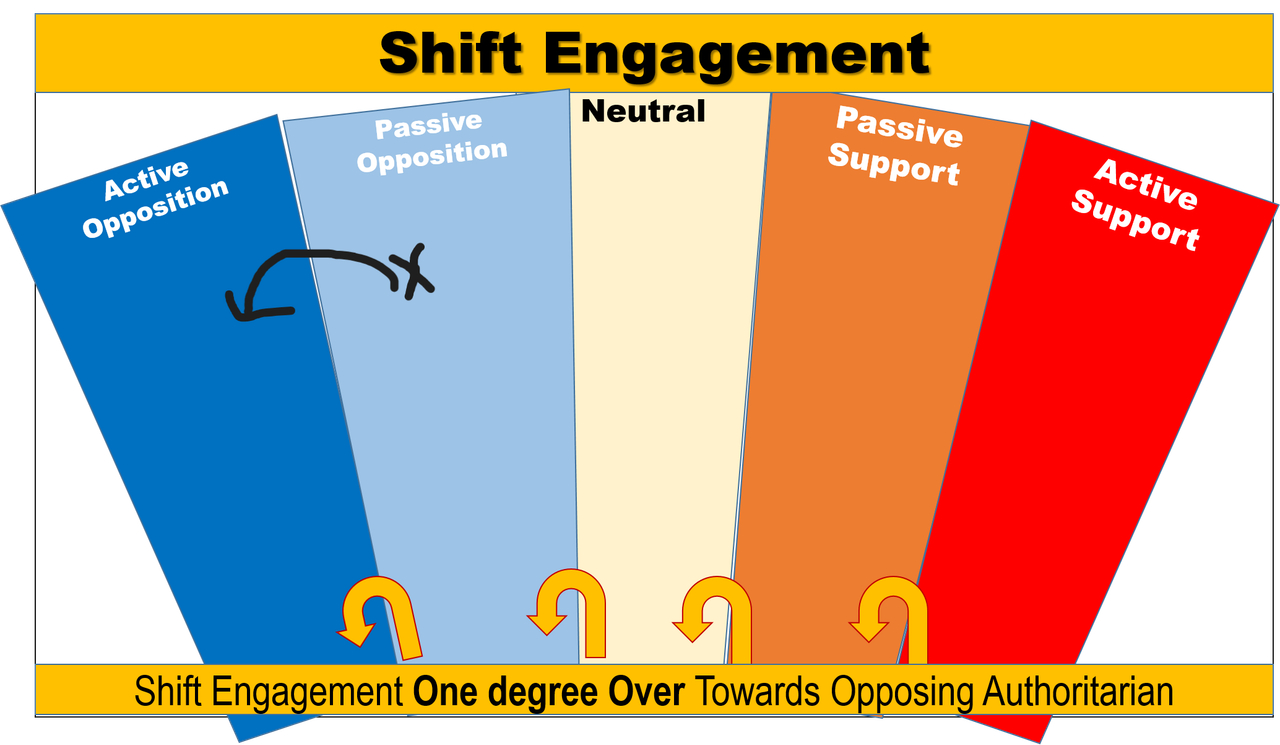
We want to focus on people that are passive opponents of this regime, not active supporters of the regime, white supremacy or fascism.
The farther away from active opposition to the regime a person is, the less likely they are to join the democracy movement. MAGA members are active supporters of the regime. This means that they are highly unlikely to join us.
There are several reasons for this:
1. They are white supremacist or fascist fanatics. They believe on what he is doing. In this case, they are fighting against, not for democracy. This people are characterized by willful ignorance. They don't want to know better because they want to BE better than others.
2. They are under a shared psychosis with the Destroyer in the White House. they may be narcissistic like him or have developmental wounds that they assuage with assigning him a father role. When this happens, according to experts, the solution is to remove the psychotic leader. Then these people slowly get off the trance.
3. They have believed the lies and aligned themselves with MAGA because they are lonely and feel abandoned by the regime, consider themselves patriotic or need a community. This was the case of many veterans who believed that the 2020 elections had been stolen. As the regime revealed his true agenda, many of these veterans left MAGA. But even then, the work to help them shift needs to be done by trusted friends or family.
So you can see that these populations are not the best way to use our limited time and resources. The graphic below illustrates the degrees of separation between active supporters, neutral people and active opposition to the regime. The audience we are targeting is marked with an X. We want to help them go from passive opposition to active opposition to this regime. That's how democracy wins!
That is why we seek online conversations under alternative/progressive news media or podcast. These people are seeking alternative answers and they are resonant with or open to alternative thinking and information that can help them get clear and mobilize.
Step 1B: Curate the Conversation: Respond
Curating the conversations online is easy. It involves 3 simple steps. You already did number one.
1A. Listen to what they are saying. What do they feel and how could these feelings be helping or hindering them from taking action on behalf of democracy? What misinformation can you dispel for them? What resources do they need that you can provide? What false beliefs you can help clarify so that they feel empowered to take action?
So now, we move to number two.
1B. Respond to these needs. We will discuss common issues and questions and provide basic answers. If you need more information, there will be training available for you.
Responses could be:
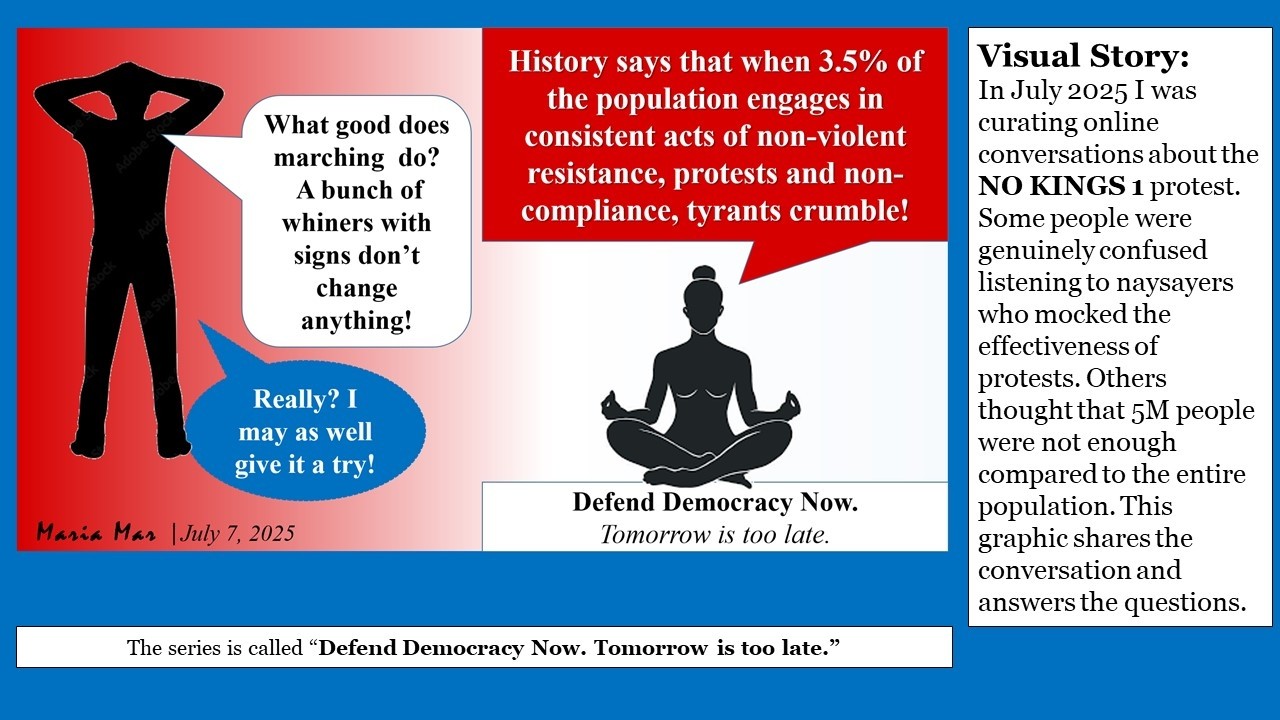
~ Dispelling a false belief or impression that is holding them back. One common example of this is believing that marching changes nothing.
~ Sharing a link to resources the person needs. A common example is to give them a link to Indivisible so that they can subscribe and stay inform. You can also give them a link to an event website so that they can learn more.
~A clarification of misinformation. So many people are upset by the reality show in the White House because the legacy media keeps repeating those lies and they don't know who to believe. By giving them a more accurate perception with new facts and add a fact-checking site, you can empower this person to find a path forward.
~A story of your own experience that resonates with them. Sometimes a person may feel like they cannot contribute to the movement because of their limitations. Example: A man who was blind and in a wheelchair was complaining that he felt powerless to respond while he saw all the programs that helped him being destroyed. I told him that he was already doing something difficult because he was in an online conversation in spite of being blind. Then I share my own experience of not being able to march because I had suffered two falls during COVID and I was not yet fully recovered. I shared how I also felt frustrated until I shifted from believing that I could do nothing because of that limitation to asking myself what resources I DID have and what I could do with them? The man responded with enthusiasm and gratitude. I could feel his agency had been fully activated and he gave me thanks for "shaking him out of the internalized ableism that often keeps people with challenges from acting on their own behalf.
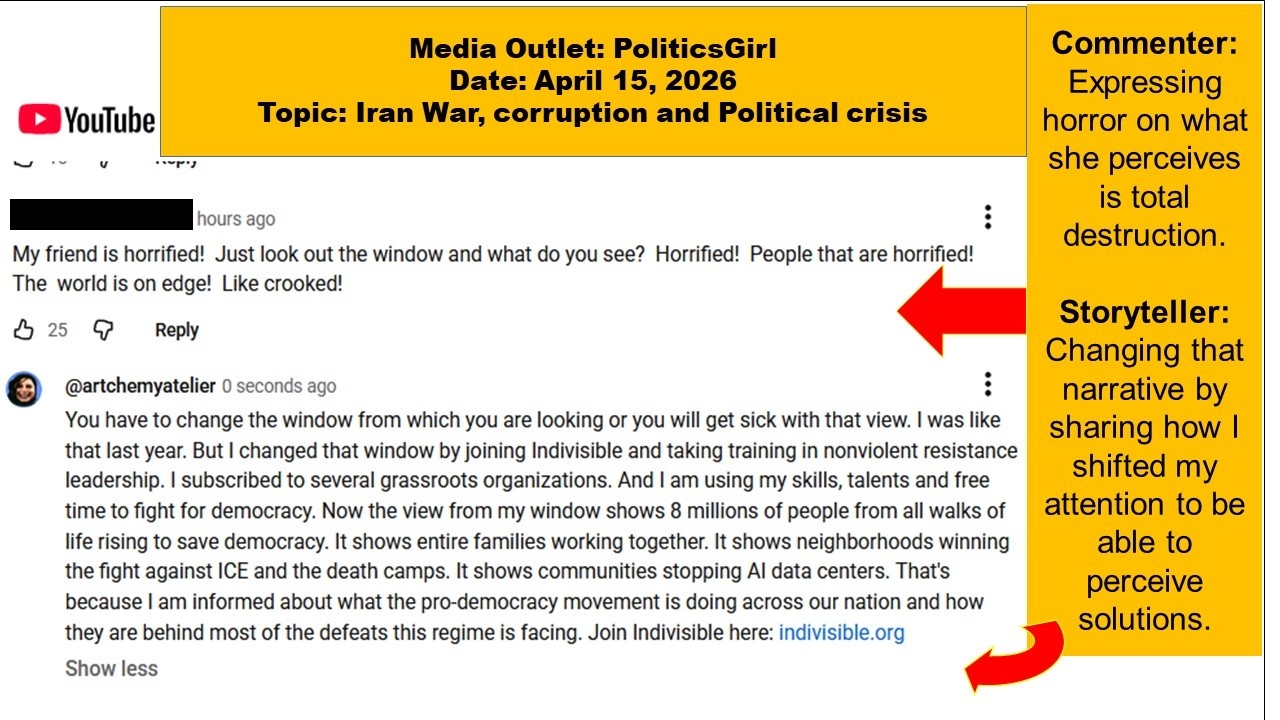
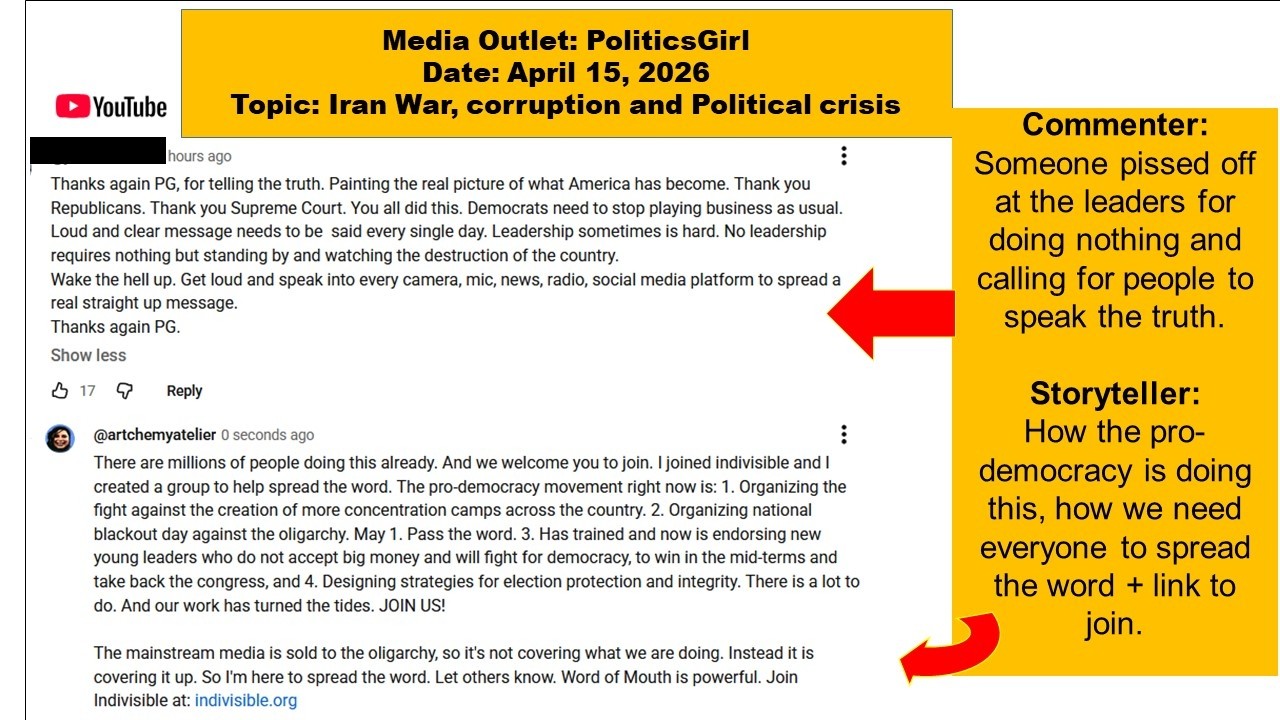
~A story about what the pro-democracy movement is doing that will get them engaged. In the screenshots below you will see some examples of this.
Once you are fluid in responding to the conversations, then you want to document them. Let's examine that step quickly below.
But before we continue, here's a note:
Online or Local Curation?
The reason I recommend starting online if you can is because you get a wide sample of people that are at the exact stage where they need our help, so your research can be both more targeted and more expansive. If you do this locally, make sure to go beyond friends and family. Listen to what your community is saying by going to Town Hall and other meetings; but make sure that you also listen in more intimate conversations where people feel safe to express their feelings.
It's counterintuitive, but people participating online in comment threads that respond to a newscaster, podcaster or political analyst that they trust are more likely to express themselves emotionally than people in a local meetings. I think this is due to the anonymity of online commenting.
But there are moments where people in a local meeting will speak up and engage their emotions. In my experience, this is when they are neighbors who know each other and are responding to a common cause. In other words, they feel a unity that opens spaces to express shared emotions and experiences. This is already happening in small Town Halls and other local situations, so that's a good place to go to listen.
Below I share snapshots that illustrate different types of responses for different needs or questions. The yellow notes are the way I use snapshots to help other storytellers. You may not need them or use them as further explanations, subtitles or prompts.
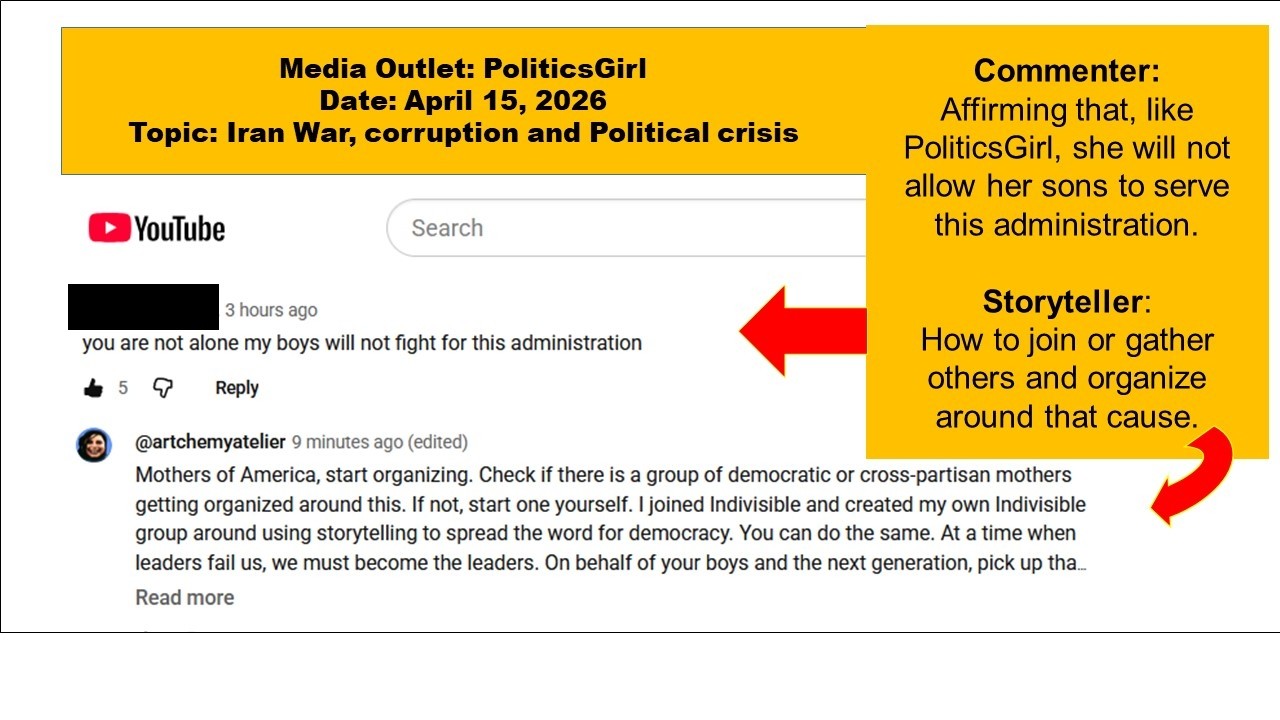
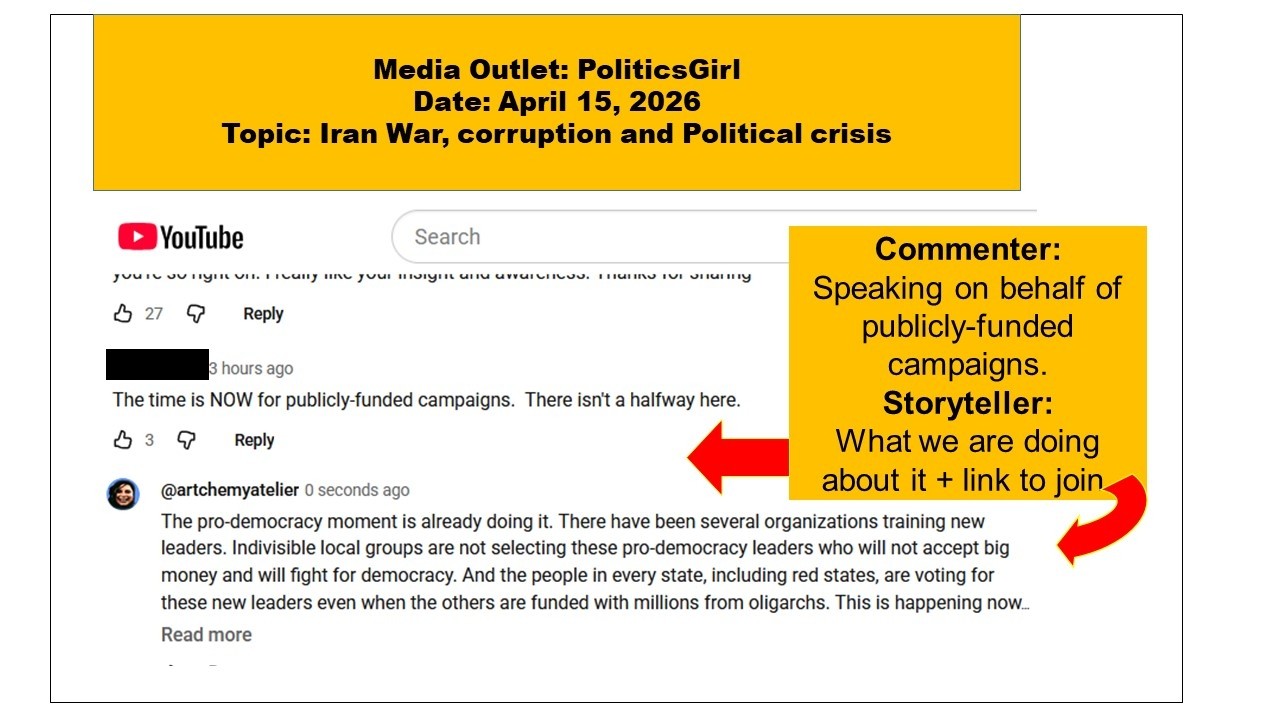
To see the screenshots better, right-click and select "Open Image in new tab" which will allow you to magnify it.
Step 1C: Curate the Conversation: Document
Documenting is the historical component in Storytelling. You need to keep a record of your curation so that you can now expand those magical moments of connection into a larger interaction.
Here are some ideas:
Create Snapshots.
You may want to take a screenshot of juicy conversation points that you can then turn into a story to share with others.
Keep Organized Records
You may keep a notebook where you keep track of common questions and answers, beliefs and limitations and need for resources.
I keep them in my notepad, in my Storytellers.Indivisible file. I have them organized by categories and topics.
Example:
Categories: Q&A, Beliefs, Limitations, Resources
Topics: Marching, Comply in advance, the military, waiting for the heroes, misinformation, info about movement, GOP, Democratic leaders, the regime, he's winning, democracy is lost, AI technology and robotics, Oligarchy, Supreme Court, judiciary, women's rights, race and Latinos, African-Americans, brown immigrants, immigrants, national finances, war, corruption, LGBTQ+ and transgender rights, etc.
That way I can do two things quickly:
1. Find and answer to curate a common question in a conversation, and
2. Review the issues to get inspired for my next story communication or project. What is trending because of the events or madness of the moment? What is compelling for me now? What has elicit further writing, emotional processes or insights for me?
Step 2: Share Stories that Change the Narrative
Now that you have your finger in the pulse of the people, you can create stories that change the narrative.
You will need three things to proceed:
Creativity, flexibility and connectivity are the three things that you need in order to do your storyteller tasks. As a Creative, I want you to make We, the People your Muse. Seek inspiration in our questions, struggles, doubts and emotions and in our dreams, courage and values.
We are in what the mesoamerican shamans call a Pachakuti. It is a rare quantum evolutionary moment that takes place every 26,000 and that these shamans have documented, studied and prepared for during millenia. If you want to know more about this, check my upcoming book where I follow these political events from the shamanic and cosmic perspective of this Pachakuti, which is an Inca word meaning "world reversal" another way of seeing this reversal is as "a time of death and rebirth" for the Earth and for humanity.
The Greeks had a name for moments like this. They call it Kairos. It's revealing that they also use the term to mean "the exact or critical time." The reason for this is that creative chaos involves a death of the old and the emergence of the new-- the rebirth. This is such a time.
And one critical aspect of how we ride such time into a better future is to "see what is emerging." The shamanic perspective helps us here because the shaman embraces paradox and as such can quickly see what is being born from the ruins of what is being destroyed.
When we see the opportunities in the obstacles, the new emerging from the destruction of the old, we can make the best of the chaos because it is created during quantum evolutionary times when growth is no longer linear, but simultaneous, immediate and multi-dimensional. We are simultaneously letting go of the old and embracing the potential emerging from that release. These are moments when the cosmos and the energy field are very fluid. And this means that there are amazing and innovative ideas and resources floating around and if you stay flexible and open in the midst of chaos and destruction, you can see and seize these moments.
When you do this, you as a storyteller can open entire new insights and possibilities for the people.
The old perfectionism is the enemy of this flexibility. We have to drop it. "Better done than perfect" needs to be a motto we embrace.
All of this to tell you this:
When you hear the people, insights, ideas and wisdom will emerge. Go for it. Tell the story. Allow the possibilities to emerge. See the answer in the question. Find and share the solution emerging from the problem. See the fresh new ideas emerging from the ruins of destruction. That is how we evolve our democracy.
And through it all keep an eye on the key to our victory: UNITY. That serves as a criteria to our stories. They must bring us together in our common purpose of restoring democracy.
Once you curate a number of conversations, you will get a direction of what people are needing at the moment. You can then proceed to your creation stage.
You can then source your communication. This happens at the intersection of people’s needs and your own creative passion.
There are many ways to help people change these narratives.
Do what you love and use what you got!
What inspired you to check out the Storytellers group?
Perhaps...
...You like to share visual stories through graphics, illustration, cartoons or other means.
... You are a teacher and love to answer questions or share insightful quotes.
... You love to share your experiences as a way to move those who may be going through the same.
... You are a performer and love to embody or bring stories alive through live events, acting, dancing or other such presentations.
... You are good at getting people to talk about their experiences and share stories.
... You love history and love to tell stories of how the problems we face started.
Then that's your path.
Now you know how to communicate your story to respond to the needs of We, the People.
Let me give you some examples of how I've taken the curated conversations and created different ways to share stories to respond to people's needs and question.
Visual Stories
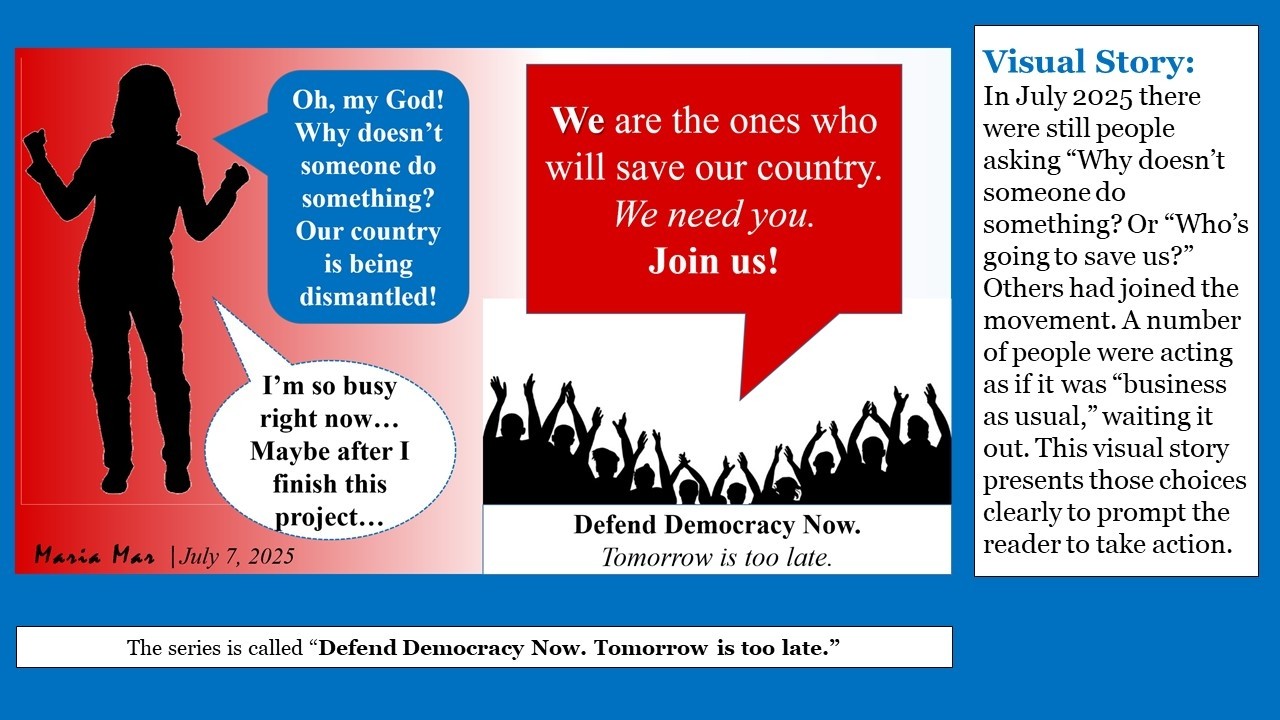
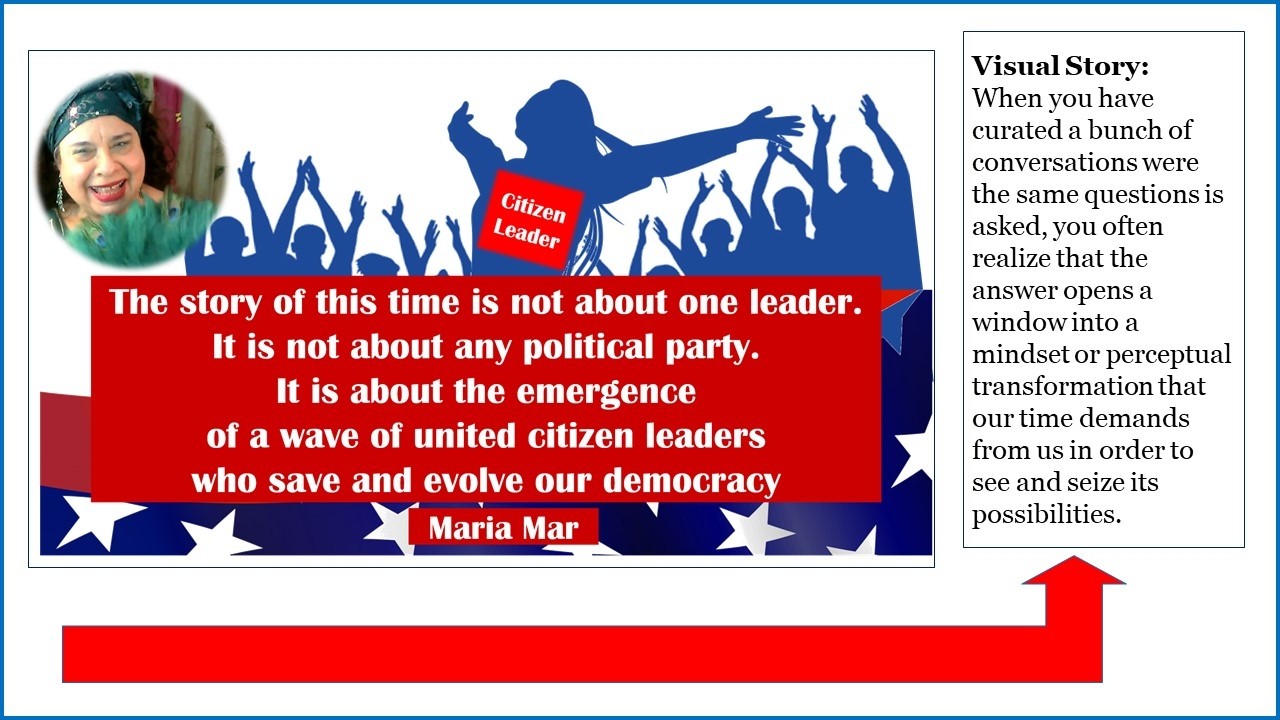
You can say a lot in less time and space when you make your stories visual. If you draw, like graphics or have a program that can help you create them-- like PowerPoint or Canva, go for it. I don't draw figures that well, but I use silhouettes to express the characters in my story. Here are three samples from one of my visual stories series.
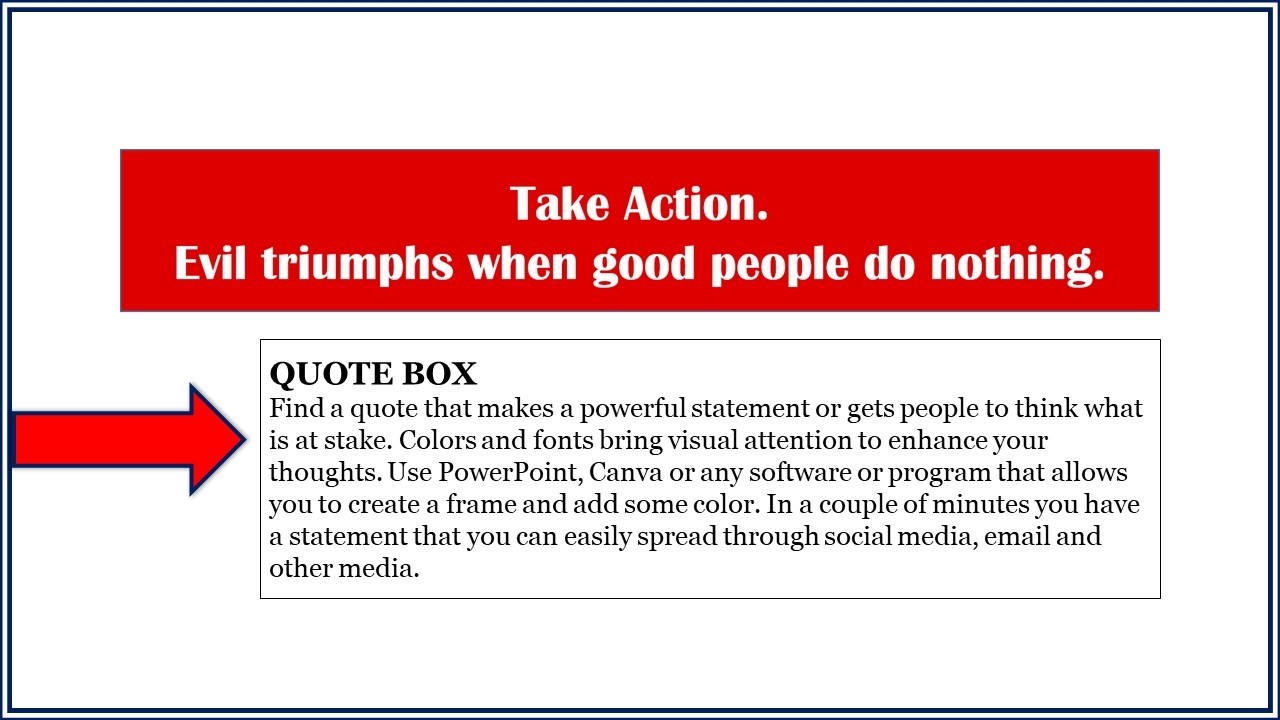
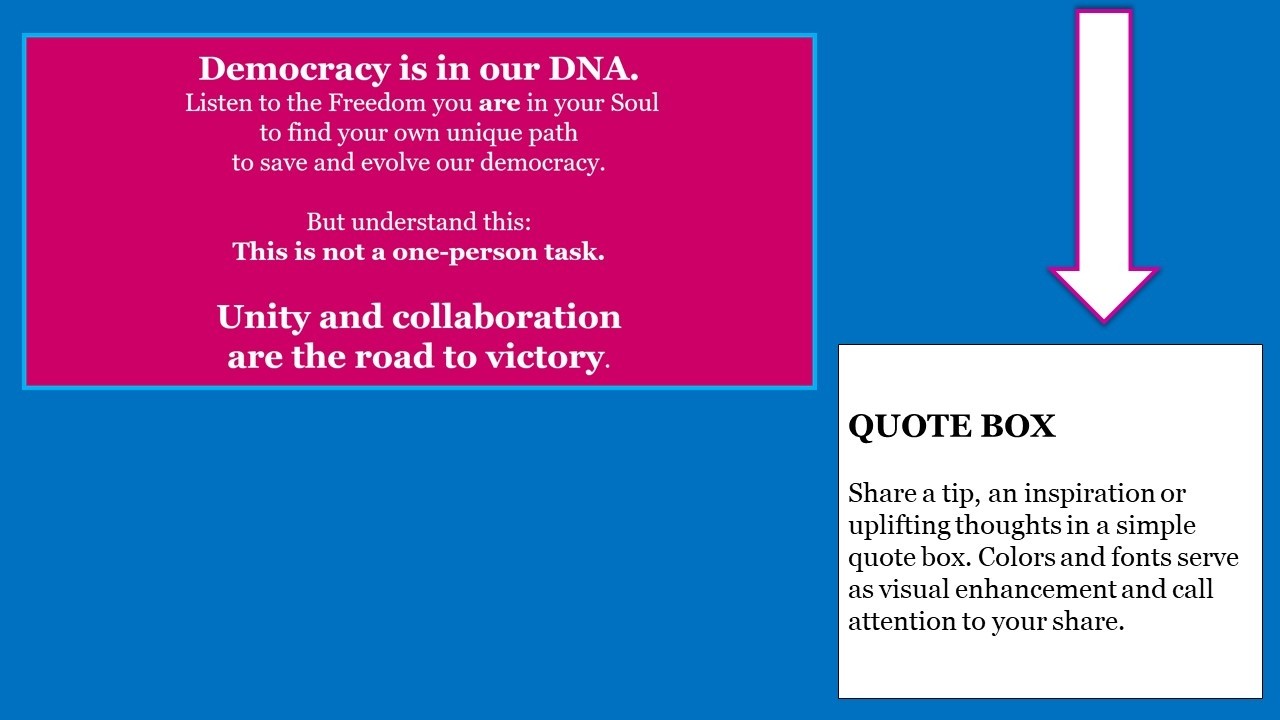
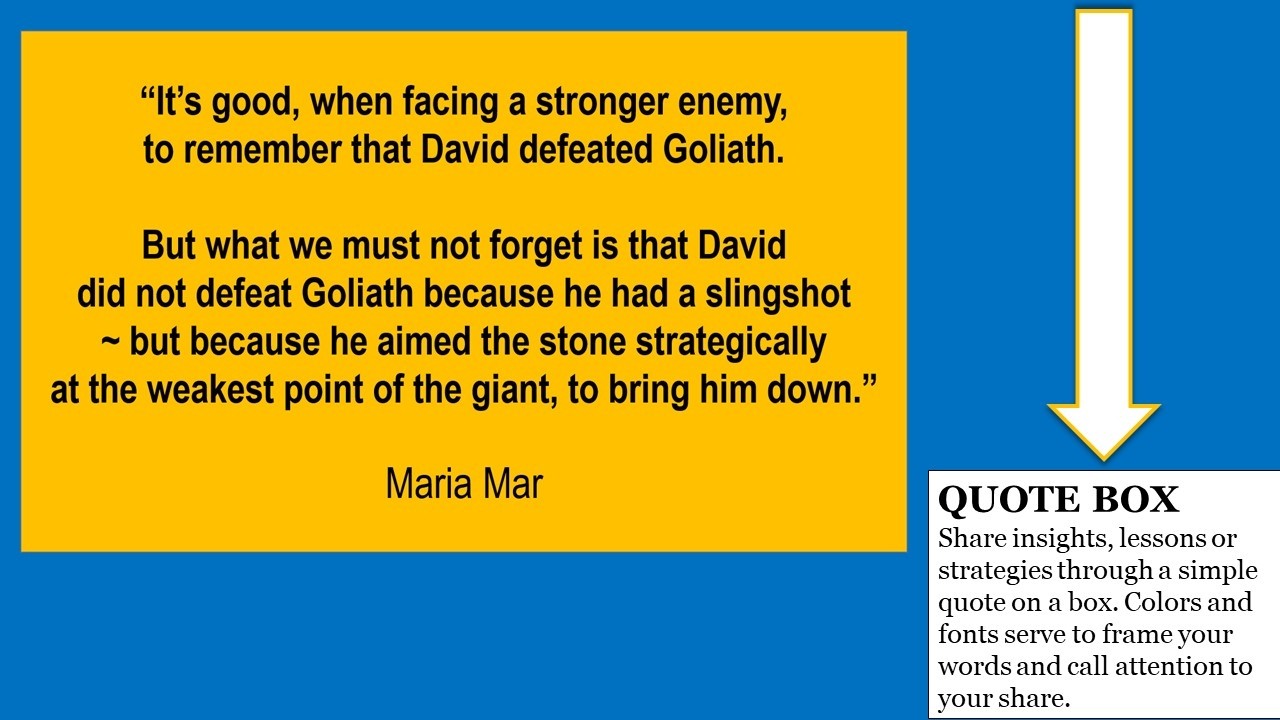
Frame it!
If you don't draw and do not want to do graphics, you can only enhance what you want to say
by putting it into a box... I mean frame!
Famous quotes, tips and insights, inspiration or strategy explainers.
It's best when you add frame and color... and you don't have to keep writing it as you share it everywhere.
To see the screenshots better, right-click and select "Open Image in new tab" which will allow you to magnify it.
Use the Medium You Like
You can use whatever form of expression you like: audio, video, graphics, social media quotes or Q&A which are super-easy to do in PowerPoint or Canva. Or you can do simple text posts. You can write letters. Create short insights. Tell a short story.
Create a visual story with a screenshot
You can turn online conversations into visuals. First you curate the online conversations. Post your answer and take a screenshot of that section with the question and your answer. (Always cover names and email addresses to protect people’s privacies.)
Then you can post the visual of that conversation and ask people if they have the same question, or what would they answer be to start another conversation in your social media or email or wherever you want.
Email Newsletter
To stay in touch, you can send an email newsletter to your community. Get their emails and permission. Then send them periodic newsletter where you share information, inspiration, notice of events and more. And don't forget to work with others in your community to create events where the people can express their free speech!
Printed Bulletin
You can make a small printed bulletin for the same purpose and distribute it in your neighborhood.
Study Groups, Book Clubs, Conversations, Event Organizing
If you are an oral storyteller, then you have a great opportunity. Gather with others in your community or field and organize monthly meetings. You can do study groups to:
~ Study about nonviolence resistance and how we defeat this fascist coup.
~ Read books about this and discuss them.
~ Share conversations that inspire, support and inform, where you can speak your truth, vent, and come up with shared solutions.
~ Organize monthly events using the strategies that Indivisible teaches.
Always include an organizing/action aspect that empowers your group to join others at events that are advancing the pro-democracy movement.
For example,
If you are a Book Club, you can join Banned Book Clubs or similar groups to fight against book banning.
If you are a Study Group, you can make a Friends and Family Pot Lock day in which you present what you have learned and have a conversation.
The sky’s the limit once you know what people need to hear.
I am here to help you figure out what to do and how. Once we get the group going, we can be a support for any story creation or project you are doing.
Once we have a core group, we will then help each other through monthly meetings.
These ideas are all examples. There is no prescription.
The only two requirements are for you to source what you do from the people and to share it with the people. That’s it.
What to do?
If you resonate with the mission of being a storyteller for our times to help change the narrative and give democracy a win, go ahead. Take two steps.
1. Click the button to join. You will be taken to a registration page and then you will land on the "Course Curriculum" page. Remember that I'm using my online service to deliver my personal growth courses. You will need your username and password when you come back.
2. Click on the first module for the preparation section and click the link to RSVP for the next Storytelling Gatherings.
Then you can go on reading the Preparation Module and go ahead and start curating conversations.
Welcome to the Storytellers.Indivisible Group!
Course Curriculum

Maria Mar
Are you struggling with putting your gifts “out there”? Then Maria is your guide to breaking free from the fears and limitations that steal your gifts from the world. Maria Mar is a storyteller, author, poet, performer, artist and shaman with more than 40 years of experience in transformation through the arts. She has helped creative women in three continents to embody their purpose, unfold their potential, share their gifts and awaken their creative genius. She is a scout for you during change and challenges and helps you go from where you are to where you want to be. Maria invites you to play for your transformation in a magical process that employs creativity to design the life you want. Maria specially loves to work with multi-talented women who are ready to be change-makers but struggle to integrate all their gifts to serve the world. Her shamanic stories are journeys of transformation, manifestation and liberation that lead to potent, immediate and deep changes in your real life.
Join this Group. Give it a try.
Storytellers.Indivisible
Free
-
Introduction. Resources. Monthly Meetings. Strategic Reports. Together we can change the narrative to reclaim our democracy.